The world's first trillionaire is predicted by UK charity Oxfam to happen within the next 10 years. Meanwhile, the global eradication of poverty will take until the mid-23rd century to achieve.

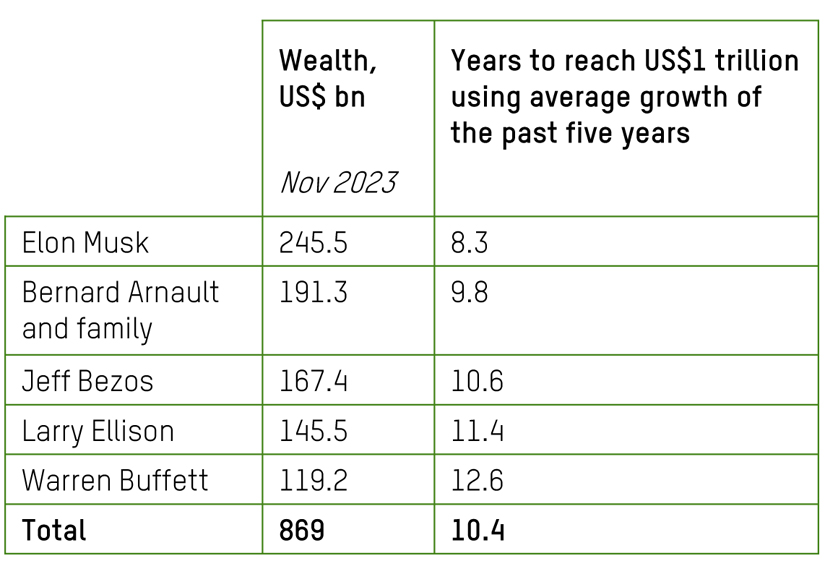
The rich are becoming richer at an even faster rate than previously thought. The world's five wealthiest people have more than doubled their fortunes from a combined $405 billion to $869 billion since 2020 – at a rate of $14 million per hour – while nearly five billion people have been made poorer. That is according to a new Oxfam report on inequality and global corporate power. If current trends continue, the world will have its first trillionaire within a decade but poverty (defined as earning less than $7/day) will take another 229 years to be eradicated worldwide.
The report, "Inequality Inc.", is published as business elites gather for this year's World Economic Forum (WEF) meeting in Davos, Switzerland. It reveals that seven out of ten of the world's biggest corporations have a billionaire as CEO or principal shareholder. These corporations are worth $10.2 trillion, equivalent to more than the combined GDPs of all countries in Africa and Latin America.
"We're witnessing the beginnings of a decade of division, with billions of people shouldering the economic shockwaves of pandemic, inflation and war, while billionaires' fortunes boom," said Amitabh Behar, Oxfam International interim Executive Director. "This inequality is no accident; the billionaire class is ensuring corporations deliver more wealth to them at the expense of everyone else."
"Runaway corporate and monopoly power is an inequality-generating machine," he continued. "Through squeezing workers, dodging tax, privatising the state and spurring climate breakdown, corporations are funnelling endless wealth to their ultra-rich owners. But they're also funnelling power, undermining our democracies and our rights. No corporation or individual should have this much power over our economies and our lives – to be clear, nobody should have a billion dollars."
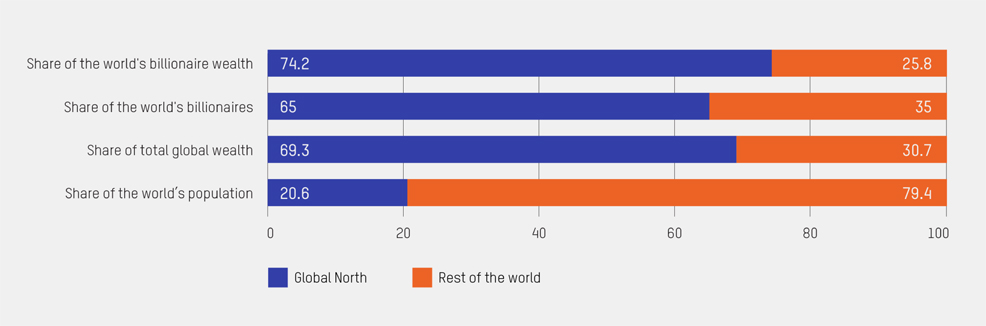
The past three years' surge in extreme wealth has solidified, while global poverty remains mired at pre-pandemic levels. Billionaires are now $3.3 trillion richer than in 2020, and their wealth has grown at triple the rate of inflation. Despite representing just 21% of the global population, rich countries in the Global North own 69% of global wealth and are home to 74% of the world's billionaire wealth.
Mirroring the fortunes of the super-rich, large firms are set to smash their annual profit records in 2023. 148 of the world's biggest corporations together raked in $1.8 trillion in total net profits in the year to June 2023, a 52% jump compared to 2018–2021. Their windfall profits surged to nearly $700 billion. Oxfam's report finds that for every $100 of profit made by 96 major corporations between July 2022 and June 2023, $82 was paid out to rich shareholders.
Some of the more notable billionaires are highlighted by Inequality Inc.:
• Bernard Arnault (net worth: US$191.3bn) is the world's second richest man. He presides over the luxury goods empire LVMH, which has been fined by France's anti-trust body for anti-competitive practices. He also owns France's biggest media outlet, Les Échos, as well as Le Parisien.
• Jeff Bezos (net worth: US$167.4bn) has increased his fortune by $32.7 billion since 2020. The US government has sued Amazon for wielding its "monopoly power" to hike prices, degrade service for shoppers and stifle competition.
• Aliko Dangote (net worth: US$10.5bn) is Africa's richest person. He holds a "near-monopoly" on cement in Nigeria, and his empire's expansion into oil has raised concerns about a new private monopoly.
Meanwhile, the wages of 800 million workers have failed to keep up with inflation and they have lost $1.5 trillion over the last two years, equivalent to nearly a month (25 days) of lost wages for each worker.
Oxfam's analysis of data from 1,600 of the largest corporations worldwide shows that 0.4% of them are publicly committed to paying workers a living wage and support a living wage in their value chains. It would take 1,200 years for a woman working in the health and social sector to earn what the average CEO in the biggest Fortune 100 companies earns in a year.
Oxfam's report also shows how a "war on taxation" by corporations has seen their effective tax rate fall by one-third in recent decades, while corporations have relentlessly privatised the public sector and segregated services like education and water.
"We have the evidence. We know the history. Public power can rein in runaway corporate power and inequality – shaping the market to be fairer and free from billionaire control. Governments must intervene to break up monopolies, empower workers, tax these massive corporate profits and, crucially, invest in a new era of public goods and services," said Behar.
"Every corporation has a responsibility to act but very few are. Governments must step up. There is action that lawmakers can learn from, from US anti-monopoly government enforcers suing Amazon in a landmark case, to the European Commission wanting Google to break up its online advertising business, and Africa's historic fight to reshape international tax rules."
Oxfam is calling on governments to rapidly and radically reduce the gap between the super-rich and the rest of society by:
• Revitalising the state. A dynamic and effective state is the best bulwark against extreme corporate power. Governments should ensure the universal provision of healthcare and education, and explore publicly-delivered goods and public options in sectors from energy to transportation.
• Reining in corporate power, including by breaking up monopolies and democratising patent rules. This also means legislating for living wages, capping CEO pay, and new taxes on the super-rich and corporations, including permanent wealth and excess profit taxes. Oxfam estimates that a wealth tax on the world's millionaires and billionaires could generate $1.8 trillion a year.
• Reinventing business. Competitive and profitable businesses don't have to be shackled by shareholder greed. Democratically-owned businesses better equalise the proceeds of business. If just 10% of US businesses were employee-owned, this could double the wealth share of the poorest half of the US population, including doubling the average wealth of Black households.
By FutureTimeLine