Rapid ocean warming and unusually hot winter days recorded as human-made global heating combines with El Niño
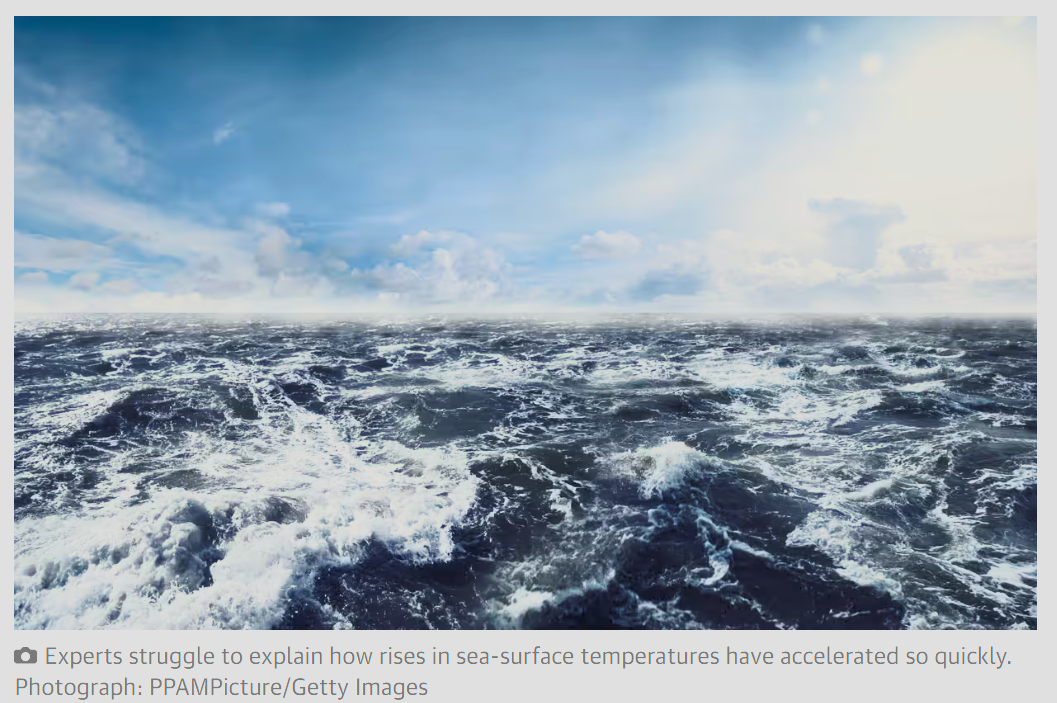
February is on course to break a record number of heat records, meteorologists say, as human-made global heating and the natural El Niño climate pattern drive up temperatures on land and oceans around the world.
A little over halfway into the shortest month of the year, the heating spike has become so pronounced that climate charts are entering new territory, particularly for sea-surface temperatures that have persisted and accelerated to the point where expert observers are struggling to explain how the change is happening.
“The planet is warming at an accelerating rate. We are seeing rapid temperature increases in the ocean, the climate’s largest reservoir of heat,” said Dr Joel Hirschi, the associate head of marine systems modelling at the UK National Oceanography Centre. “The amplitude by which previous sea surface temperatures records were beaten in 2023 and now 2024 exceed expectations, though understanding why this is, is the subject of ongoing research.”
Humanity is on a trajectory to experience the hottest February in recorded history, after a record January, December, November, October, September, August, July, June and May, according to the Berkeley Earth scientist Zeke Hausfather.
He said the rise in recent weeks was on course for 2C of warming above pre-industrial levels, though this should be the brief, peak impact of El Niño if it follows the path of previous years and starts to cool down in the months ahead.
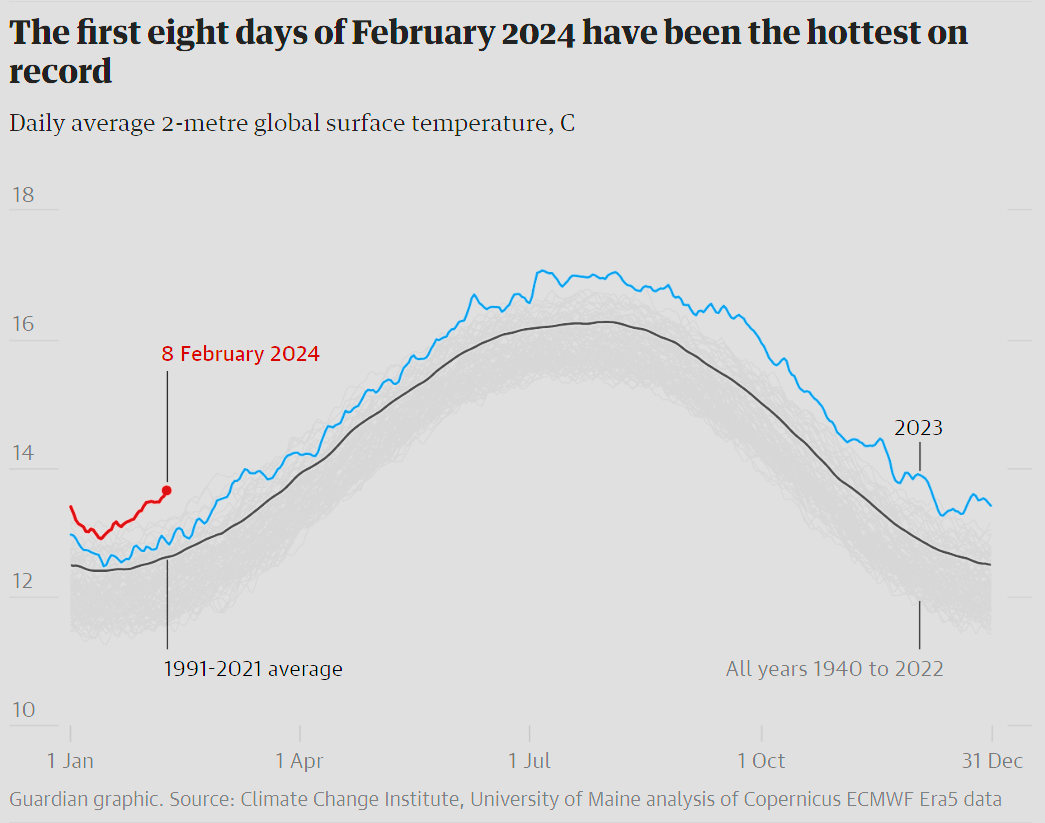
That would normally be good news if a temperature-lowering La Niña follows, but Hausfather said the behaviour of the climate had become more erratic and harder to forecast. “[Last year] defied expectations so much that it’s hard to have as much confidence in the approaches we have used to make these predictions in the past,” he said. “I’d say February 2024 is an odds-on favourite to beat the prior record set in 2016, but it’s by no means a foregone conclusion at this point as weather models suggest that global temperatures will fall back down in the coming week. So while I think these extreme temperatures provide some evidence of an acceleration in the rate of warming in recent years – as climate models expect there to be if CO2 emissions do not fall but aerosols do – it’s not necessarily worse than we thought.”
The first half of February shocked weather watchers. Maximiliano Herrera, who blogs on Extreme Temperatures Around the World, described the surge of thousands of meteorological station heat records as “insane”, “total madness” and “climatic history rewritten”. What astonished him was not just the number of records but the extent by which many of them surpassed anything that went before.
He said Morocco had seen 12 weather stations register over 33.9C, which was not only a national record for the hottest winter day, but also more than 5C above average for July. The northern Chinese city of Harbin had to close its winter ice festival because temperatures crept above freezing for an unprecedented three days this month.
In the past week, monitoring stations as far apart as South Africa, Saudi Arabia, Thailand, Indonesia, Kazakhstan, Colombia, Japan, North Korea, the Maldives and Belize have registered monthly heat records.
In the first half of this month, Herrera said 140 countries broke monthly heat records, which was similar to the final figures of the last six record hottest months of 2023 and more than three times any month before 2023.
Ocean surface heat continues to astonish seasoned observers and raises the prospect of intense storms later in the year. The hurricane specialist Michael Lowry tweeted that sea surface temperatures across the Atlantic main development region, where most of the US category 3 or stronger hurricanes form, “are as warm today in mid-February as they typically are in middle July. Incredible.”
Global sea surface temperatures are in “uncharted territory” according to Hirschi, who expects March to break last August’s record by 0.1C to 0.2C. March is typically the hottest time of the year for oceans because it is late summer in the southern hemisphere, which is home to most of the world’s great seas.
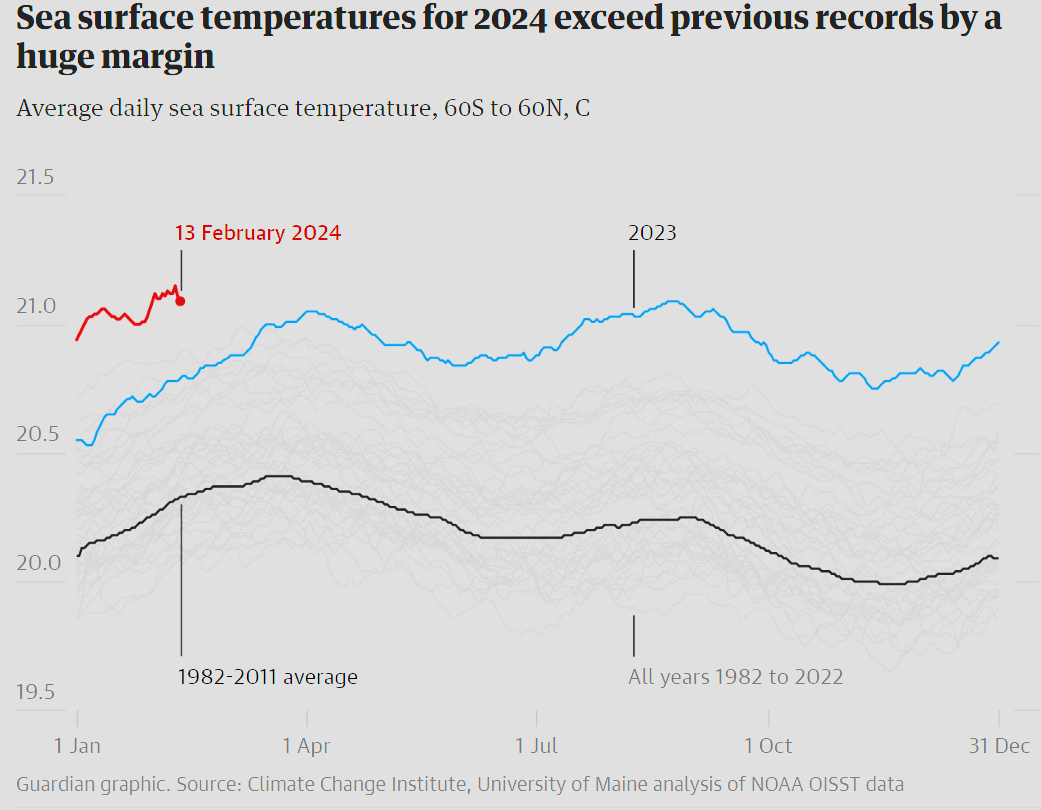
The temperature spikes were expected, though their amplitude came as a surprise. Climatologists are now studying how to attribute weight to the different causes behind such anomalies.
A strong El Niño has pushed temperatures higher, but Francesca Guglielmo, a Copernicus senior scientist, noted this was only one of several heating factors that worked in combination. Every extra tonne of carbon dioxide emitted by humanity increases pressure on the oceans. In some areas, the anomalous heat has also been intensified by weak trade winds, a lethargic jet stream, fluctuations in North Atlantic circulation and reductions in aerosol pollution, which exposes more of the ocean to the sun.
Katharine Hayhoe, chief scientist for The Nature Conservancy, said the uncertainty about the interaction of the different factors was a reminder that we do not fully understand every aspect of how the complex Earth system is responding to unprecedented radiative forcing. “This is happening at a much faster rate than ever documented in the past,” she said. “If anything, we are much more likely to underestimate the impact of those changes on human society than to overestimate them.”
El Niño is now weakening, which should ease temperatures in the equatorial Pacific from late spring or early summer. If the North Atlantic remains warm at that time, this could herald intense hurricane activity, Hirschi warned.
Such risks will increase every year unless human carbon emissions are slashed and forest clearance reversed. “Slowing, stopping or reversing the warming trajectory we are on is akin to changing the course of a supertanker. Results are not immediate but the sooner we take action, the easier it will be for us to avoid hitting trouble,” he said.