It will take months for supply chains to correct themselves.
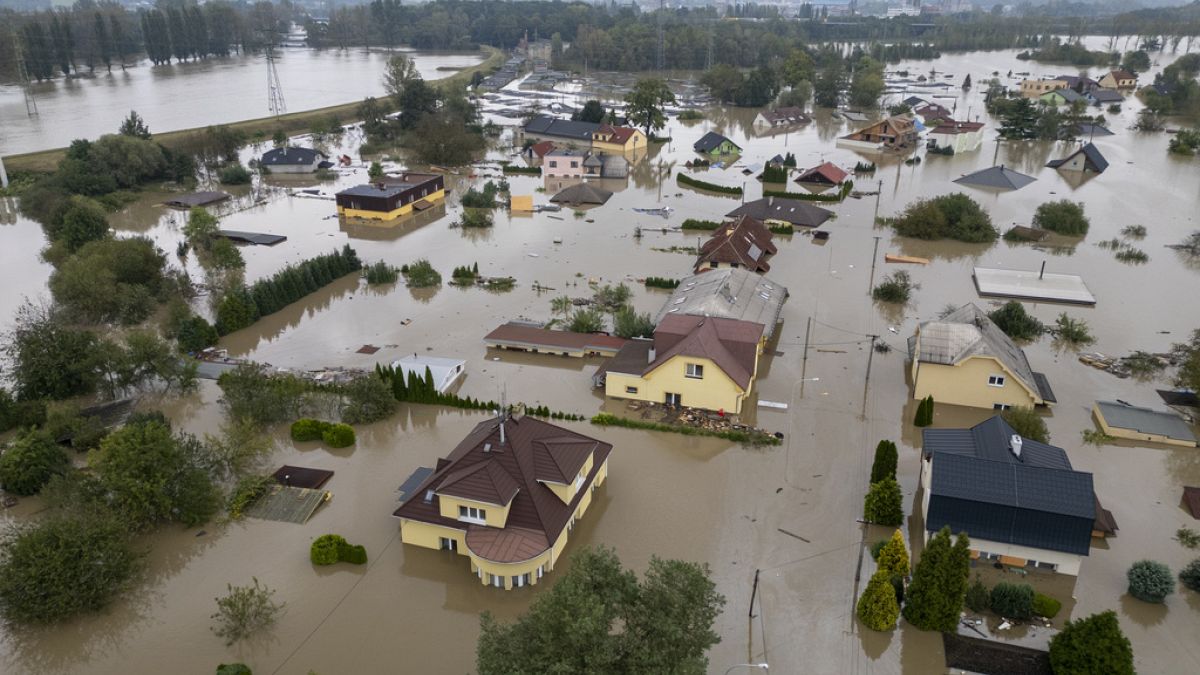
Floods rocked Central and Eastern Europe last week, inundating Poland, the Czech Republic, Slovakia, Austria, Hungary and Romania with the worst water levels they’ve seen in two decades. Though advanced predictions mitigated what could have been a worse disaster in terms of human casualties, the floods will nonetheless have implications for the national politics of affected nations and the European Union as a whole.
Southern Poland and northern Czech Republic were reportedly hit hardest, with thousands evacuated as the governments declared states of natural disaster. It’s unclear just how extensive the economic damage is. Agriculture and energy infrastructure has been shut down in some places, and many businesses have suspended their activities. The inundated regions are home to several industries, including a thriving chemical sector and one of the continent’s largest coke manufacturers.
More important is the damage to regional transportation. Based on estimates from local officials, the damage to transportation infrastructure could reach a combined $10 billion in Poland and the Czech Republic alone. Some 12 rail lines were closed in southern Poland, and rail crossings into the Czech Republic are impassable. Austria’s national railway has yet to estimate the amount of work needed to fully recover from the damage. According to local reports, restoration of the country’s busiest train line will take months. Part of the Adriatic line going into northwestern Italy will not be functional for at least another week. In Romania, much of the southeastern area along the Danube delta and the Black Sea has been affected, and roughly 100 kilometers (60 miles) of railway between Galati and Barlad remain halted. Trains from Ukraine into Poland have also been temporarily suspended. In simple terms, this means that Central and Eastern Europe’s supply chains have been severely disrupted and will not return to normal for months.
The EU has pledged billions of euros to assist affected nations, including an extra 10 billion euros ($11 billion) for immediate repairs. But it’s unclear how much of this total Brussels will cover, especially considering it could be forced to address other emergencies in the near future: Western Europe is now also experiencing heavy rainfall, and there is potential for another refugee wave from Ukraine, where the war is intensifying and energy infrastructure has been a major target of Russian attacks.
European insurers note that flooding is growing more frequent thanks to new climate patterns. Indeed, Central Europe has seen many such disasters lately: in Italy and Slovenia in 2023, the Bernd floods of 2021, and major floods in 1997, 2002, 2010 and 2013. Earlier this year, Germany and Switzerland also experienced exceptionally severe rains. Clearly, European countries will need to invest in flood resilience, and though their governments’ will do what they can, they will need to be buttressed by private funding.
Slovenia, which is still recovering from last year’s floods, is a textbook case of the economic challenges European countries face with regard to natural disasters. In October 2023, the government in Ljubljana said the floods inflicted nearly 10 billion euros worth of damage. Affecting 183 of 212 municipalities, the floods wreaked havoc on Slovenian supply chains. They also shut down industrial production, especially automotive production. And since every automobile in Europe has at least one Slovenian-made part, parts shortages affected manufacturing throughout the Continent, including that of Volkswagen, which announced production slowdowns at the beginning of 2024. With costs for repairing the damage reaching an estimated 2.3 billion euros by 2028, the government adopted a long-term program to address reconstruction needs. Yet for a variety of reasons, including post-flood relief payments, Slovenia’s national budget for 2023 showed a 2.3 billion euro shortfall. Its budget deficit in the first eight months of 2024 was 431 million euros, which is still on track for a targeted deficit of 3.8 percent of gross domestic product.
However, to keep the country economically stable, the government raised the corporate income tax and imposed a temporary charge on banks to support post-flooding initiatives. Separate from regular allocations, a dedicated budget fund was created for projects connected to floods and landslides. Income from a 0.2 percent tax on bank balance sheets and a 3-percentage-point rise in corporate tax will be included in this fund. To help companies in recovery, a guarantee system with subsidized interest rate loans has also been established. Also included are incentives for businesses in flood-affected regions that provide co-financing opportunities until December 2024. The bottom line is: To deal with the flood damage, Slovenia has undergone a full fiscal restructuring to guarantee long-term economic sustainability. Given its political stability and modest population of about 2 million, it was relatively well-equipped to do so.
The problem is that many Central and Eastern European nations are not. Before the floods, the Czech Republic was on course to become the first nation in the area since COVID-19 to lower its budget deficit to below the target of 3 percent of GDP imposed by the EU. Now, local government estimates suggest that the damage to infrastructure there and in Poland might cost $10 billion to fix. Extreme weather-related economic losses, then, are intensifying the pressure on state budgets in a region that is still struggling after the pandemic and after Ukraine war-related inflation.
Elections in Poland, Hungary and Romania, with their inevitable promises of largesse, have increased already high budget deficits. Romania’s deficit was 6.6 percent of GDP in 2023 and could be as high as 7 percent this year. Poland’s deficit is expected to reach 6 percent, while Hungary’s could top 5 percent. Budgets have also been stretched by higher military expenditures, inflation-linked spending on pensions and increased debt servicing costs. The floods affected regions that are highly dependent on Germany, and because the German economy is expected to slump, these countries may soon be facing a recession as well.
The long-term implications are many. Public finances will be under strain at a time when government funding costs remain high. In 2023, the highest apparent cost of general government gross debt in the EU was reported by Hungary (6.8 percent), followed by Poland and Romania (both 4.5 percent). Fiscal restructuring – which will translate into higher taxes and/or austerity programs – may come with high political costs. Political considerations have forced Romania to postpone many policy decisions. It has yet to even reveal a 2025 budget, and because it’s a presidential election year, it will drag its feet as long as it can. However, Romania was among the least affected countries, so it can afford to kick the can down the road.
Likewise, Poland and Hungary are in no rush to announce spending plans to deal with the post-flood damage because any decision may trigger internal political instability. In the Czech Republic, regional election results from last weekend show that there is a good chance that the ANO – the country’s populist party and current opposition – will return to power, after losing in 2020 to a very pro-EU, pro-NATO and pro-Ukraine coalition. After all, this is a region where internal politics matter for the countries’ foreign policies, especially since populism, including anti-EU and anti-NATO varietals, is on the rise.
By Antonia Colibasanu - GeopoliticalFutures